A Crisis in Plain Sight
In 2024, the U.S. Surgeon General declared parents' mental health an urgent public health issue. The advisory cited a Pew Research study which found that ~70% of American parents believe parenting is harder now than 20 years ago. The top two reasons cited were kids' use of screens and social media.
But this problem is not limited to the U.S. There are ~2 billion children worldwide and over one-third i.e. more than 600 million have internet access. More kids are expected to get internet access in the coming years, that will only exacerbate this problem. In the U.S., children aged 2-8 spend 2.5 hours daily on screens, time that hasn't decreased since the pandemic.
For parents, screens provide crucial relief: several hours of reclaimed time daily. If healthier alternatives could deliver the same engagement, the screen time debate would end overnight & we wouldn’t be writing this or starting a company. But so far, nothing has succeeded.
Why Alternatives Fall Short
Educational Apps
Platforms like PBS Kids and Khan Academy Kids are completely free. Commercial apps like Lingokids and ABCmouse generate over $10M annually with millions of users. Most of these apps have strong efficacy data around learning outcomes. Yet there's a critical gap: engagement.
Khan Academy shows positive learning outcomes with just 30 minutes of weekly usage, but their efficacy study in 2024 found less than 10% of children reach this "minimum effective dose." Smaller gains are associated with another 15% of children who used the product 15-30 mins per week. Thus, they deliver learning outcomes to only 1 in 4 of their users who are the most motivated & engaged. This is for Khan Academy but this pattern is consistent with educational apps for kids & their efficacy studies as well.
Most kids educational apps draw limited engagement a day with the majority time spent watching videos. This is illustrated by the breakdown of the daily time spent by kids below from the Common Sense Media Report. These apps also fail to solve parents' core need i.e. daily, sustained engagement that reclaims meaningful time.
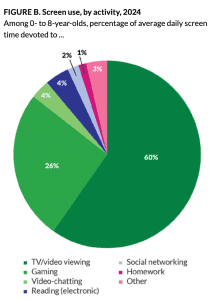 Daily Screen Use Breakdown for 0-8 year olds. (Source: Common Sense Media Report)
Educational Video Content
Before screens arrived in a child’s life, there was the television. It was frequently called the Idiot Box and parental anxiety around TV viewing was almost as high as it is for screens today. But Sesame Street’s content proved that it was possible to deliver educational value through the medium. They became the largest educational success story on television and an inspiration to many.
Quality educational media continues to exist, from Sesame Street's proven content to popular creators like Ms. Rachel. However, with screens, video platforms like YouTube have come to dominate the largest timeshare of kids’ screen time.
While these platforms host lots of quality content, they almost always lead to excessive screen use, frequently lead kids to unsafe or inappropriate content and some of them also have ads that could be problematic for young kids. 46% of parents report their children encountering inappropriate content on YouTube.
Screen Free Alternatives
Smart Speakers: Audio-only devices like Alexa, Toniebox, and Yoto offer screen-free entertainment. While general smart speakers have high household penetration (49%), & child specific ones are also starting to reach the masses (8%), Common Sense Media reports that 66% of children spend less than 15 minutes daily with these devices. They are unable to compete with the visual appeal and interactivity of screens & hence have been unsuccessful at reducing overall screen time instead complementing it.
Toys: There are lots of toys educational & otherwise available in the market. But none of them have been able to sustain high daily engagement at scale. Even LEGO, with one of the highest replay value struggles to provide the hour-plus daily engagement needed to meaningfully substitute screen time. Toys so far have been unable to match the endless novelty and choice that screens offer.
What Research Reveals About Effective Screen Time
Decades of research point to a clear solution: co-viewing with engaged adults transforms passive screen consumption into active learning. When parents watch with children and pause to ask questions, connect content to real experiences, and encourage problem-solving, passive viewing becomes educationally powerful.
Arriving at a Potential Solution
Sesame Street was built with the goal to "master the addictive qualities of television and do something good with them.” (Source: Wikipedia)
Their success made TV good for kids. We need to apply the same approach to master the addictive qualities of screens and do something good with them in order to make screens good for kids.
Our approach rested on leveraging the natural pull of video platforms and then blend the efficacy of interactive learning activities of the educational apps with one another. But how do we seamlessly blend the two?
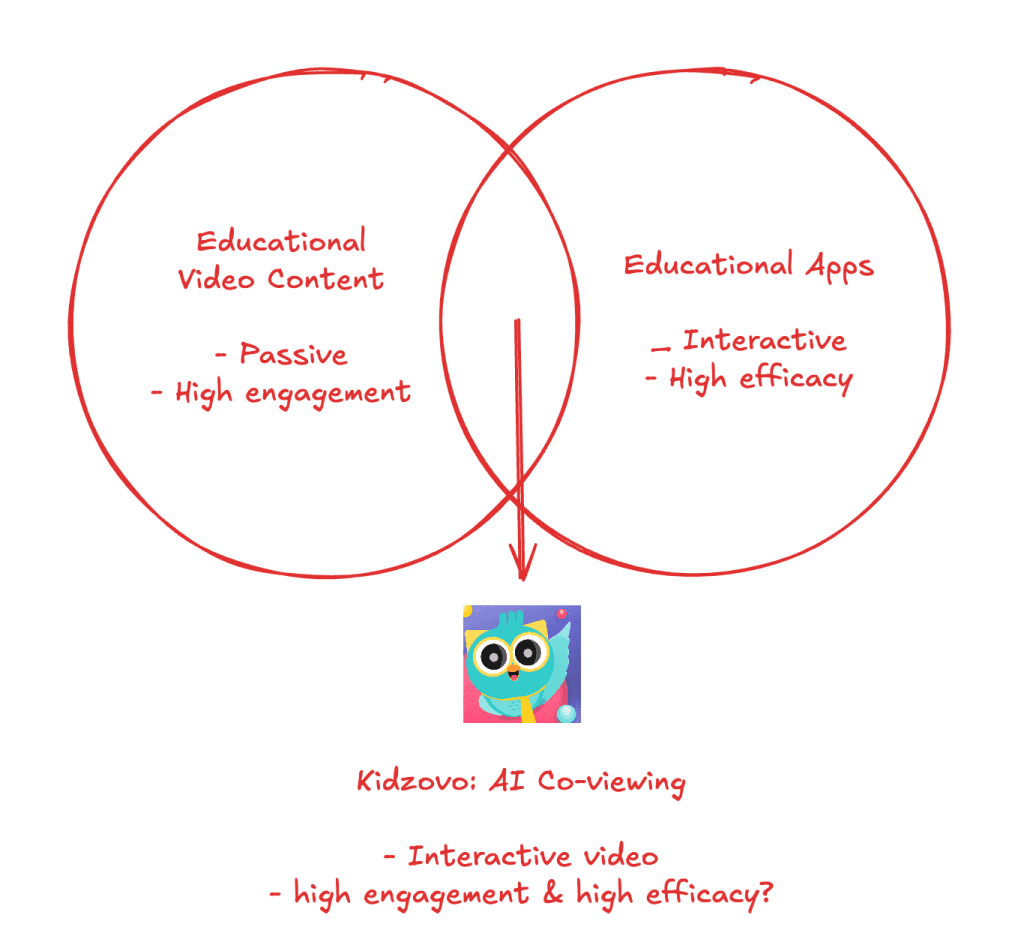 Educational media is passive but is able to get high engagement while educational apps are interactive and have high efficacy. Kidzovo combines the two with AI co-viewing & interactive activities.
The AI Co-Viewing Hypothesis
Research already suggests that parental co-viewing can make screen time beneficial for kids. What if kids had a digital companion who could co-view & provide the questioning, context, and interaction that makes screen time beneficial, without requiring constant parental supervision? This companion could layer proven interactive learning activities on top of engaging & high quality video content.
This idea lead to the creation of Kidzovo. It uses an AI companion, "Ovo" that transforms any video content into an interactive learning experience by:
- Pausing videos to ask contextual questions
- Encouraging children to find objects, speak answers, and actively engage
- Adapting interactions to individual responses and interests
- Working across diverse content types from science videos to stories
Unlike other AI companions for kids, it doesn’t expose an LLM directly to kids. Instead, AI generates contextual activities offline & then educators review the generated activities and approve them so the companion only uses activities and conversations that are pre-vetted for quality & safety.
Early Signs
After two years of development and testing, several patterns have emerged:
Engagement: Children consistently use Kidzovo for 20-25 minutes daily, less than their typical 90 minutes of passive video watching, but double the ~10 minutes that most educational apps typically achieve. Not only that, they also stick with the platform for longer periods of time. Again consistent with our hypothesis since video platforms have much higher retention than educational apps.
Behavioral shifts: In early testing, children initially tried to skip interactive elements but later began requesting Ovo's "games" within videos. When activities were moved to video endings, children were more likely to abandon content without mid-video interactions.
Self-regulation: Multiple parents reported children naturally stopping after 20-30 minutes and reducing overall passive video consumption.
However, these observations come from small-scale, short-term testing. They represent early signals, not definitive proof of effectiveness or long-term sustainability. We need more rigorous testing of this approach, both in the form of independent research studies as well as more data points from kids’ usage of the platform.
Moving Beyond False Choices
We need solutions that are simultaneously highly engaging and genuinely beneficial for child development. The screen time debate has been stuck for too long between "screens are harmful" and "screens are inevitable." Perhaps it's time to focus on a different question entirely: How can we make screens genuinely beneficial for child development while maintaining the engagement that makes them compelling?
The answer may transform how we think about kids’ screen-time entirely.